Five of our favourite new features on 42 Things To Do
From a smarter quiz and map-based discovery to Challenges and help from other people, here are five changes we've made to 42 Things To Do which are making it easier to find something worth doing.
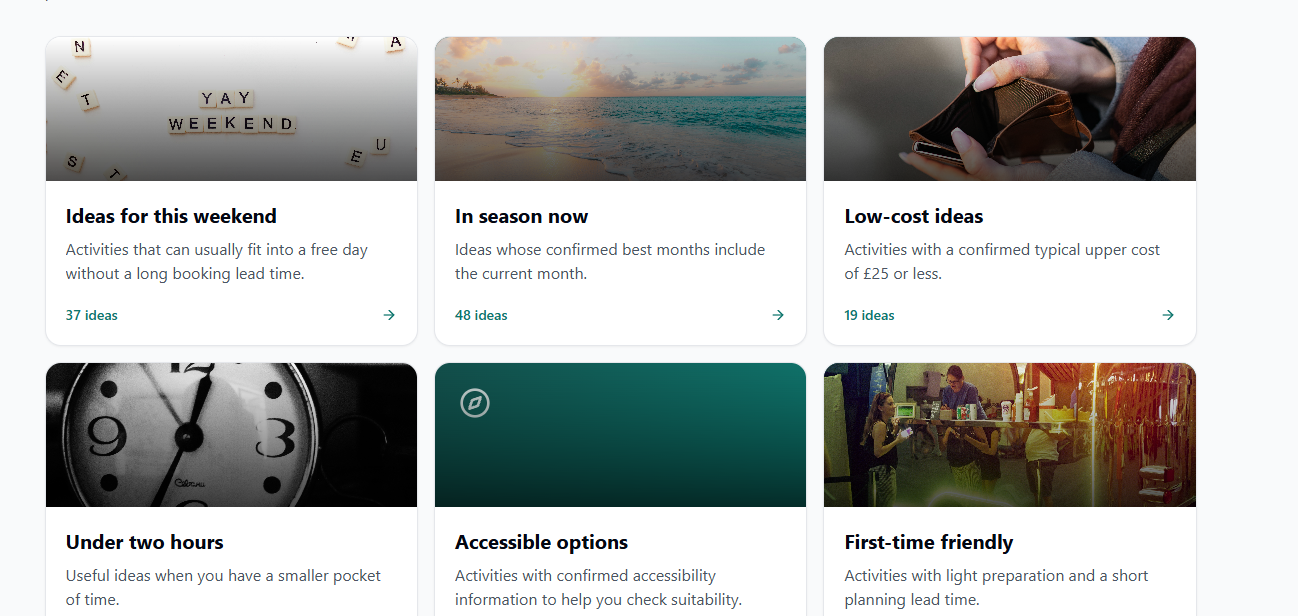
We’ve made a slightly ridiculous number of changes to 42 Things To Do over the past few months. A lot of them came from using the platform ourselves and running into the same problems anyone else would. Having nearly 2,000 activities to explore is brilliant, until you’re staring at nearly 2,000 activities and have no idea where to begin. Adding something to a list is easy, but actually getting around to doing it is rather harder. We originally planned to choose our five favourite changes for one article. We couldn’t narrow it down without ignoring half the work we’ve done, though, so we’re splitting it into two parts instead. This first one is about finding things that genuinely suit you, discovering ideas in different ways and getting a bit of help from other people when you’re ready to do something. 1. A quiz that pays attention to what you actually do The 42 Things quiz has always been designed to help you understand the kinds of experiences you’re drawn to. We’ve now made the scoring much more accurate, so the results give us a better picture of your interests and can recommend more relevant activities. There’s another part to it that I find much more interesting, though. What people say they want to do and what they actually choose aren’t always the same thing. You might tell us that you want more adventure and travel in your life, then fill your list with learning goals, creative projects and things you can do at home. Neither answer is wrong! But the difference between them can be useful to understan more about yourself. Your quiz results tell us what you feel you want more of. Your list shows us the ideas that have genuinely appealed to you when you’ve been browsing. We can now compare the two and use that to build a more accurate picture of you. Perhaps your list confirms that you already know yourself pretty well. Perhaps it shows that you think you’re Bear Grylls, while your choices suggest you’d actually rather learn pottery and visit a nice museum. More importantly, it can help you spot where your list has become a bit too familiar. If you said you wanted more adventure but keep choosing the same kinds of activities you already do, we can help you try something different. You can take the quiz here . 2. Exploring activities on a map Some activities make sense wherever you happen to be. You can bake a loaf of bread, write a poem or learn to play a song without needing to travel very far. Others belong somewhere. You visit the Taj Mahal in Agra. You climb Kilimanjaro in Tanzania. You eat sushi in Tokyo, see the Northern Lights in Scandinavia or visit the pub with the longest name in Britain, if that happens to be the sort of important cultural achievement you’re working towards. You can now switch from the normal activity list to a map and explore those ideas by location. That makes it much easier to see what’s around you, but it should also be useful when you’re planning a trip. If you know you’re heading to Italy, you can look around the country and find activities that might be worth adding while you’re there. If you’re spending a weekend somewhere closer to home, you may find something interesting that you didn’t know existed. We’ve been adding proper location information to more activities so the map will continue to become more useful as that work progresses. It also gives us a much better way to handle activities that can be done in several places rather than pretending every idea fits neatly into one location. You’ll find the map switch at the top of the activities page . 3. Collections for when you need a sensible place to start Search works brilliantly when you know what you’re looking for, but often you don’t. You may simply have a free Saturday, a limited budget or a couple of hours to fill. Typing “something interesting that doesn’t cost much and won’t require me to reorganise the next six weeks” into a search box is asking quite a lot of it. Collections give you a quicker place to begin. We currently have collections for: Things you could do this weekend Activities that are in season now Low-cost ideas Things that take less than two hours Accessible options First-time-friendly activities Ideas for trying something unusual These aren’t hand-picked lists based on a vague feeling that something seems cheap or easy. They use the practical information attached to each activity, including cost, duration, planning time, accessibility and preparation. The weekend collection, for example, focuses on things that can usually fit into a free day without needing to be booked months ahead. The low-cost collection uses activities with a confirmed typical upper cost of £25 or less. The seasonal collection changes according to the current month. We’ll add more collections over time, particularly as we improve the practical information across the full activity library. You can browse all the current collections here . 4. Challenges We’ve already written about Challenges in more detail, but there was no chance they were being left out of our favourite new features. A challenge gives you a selection of activities, a target for how many you need to complete and a deadline. Other people can take part at the same time, so you can see that you’re working towards something together without everyone having to choose exactly the same activities. The challenge itself can be deliberately manageable. Complete three things in seven days. Do six things in six weeks. Finish one meaningful activity each month for a year. You can choose simple things you’ve been meaning to do for ages, tackle something more ambitious or mix the two. Baking bread counts. So does climbing a mountain. We’re not going to tell you which one will leave your kitchen in a worse state. There are official challenges created by the 42 Things team, and you can also create your own for friends, family, colleagues or a wider community. The point is to give your list a bit of movement. A deadline helps. Having other people taking part helps too. Most of us are remarkably good at postponing things when nobody else knows we planned to do them. You can see the current 42 Things challenges here . 5. Getting help from people, not just pages An activity description can tell you a lot, but sometimes you need to hear from someone who has actually done it. Every activity can now have its own community posts, blogs and questions. You can share progress, write about your experience or ask something practical before you begin. That could be a question about the best time to go, what equipment you need, how physically demanding something really is or whether an experience lived up to the photographs. Answers also connect back into the wider community, so useful information doesn’t disappear into an isolated corner of the site. We’ve also added Do this together . Some things are perfectly enjoyable alone. Others are easier, safer or simply more fun with another person. Do this together gives you a way to start that process from the activity itself. You can also privately indicate that you’d be interested in doing an activity with company. That doesn’t immediately open your inbox or allow strangers to contact you. It records the interest privately, giving us a safer foundation for helping people find suitable company as the feature develops. Taken together, these changes make activity pages far more useful. They’re no longer simply descriptions of things you might do one day. They’re becoming places where you can plan, ask questions, learn from other people and begin turning an idea into something real. And that’s only the first half. In part two, we’ll cover the changes that help once something is on your list: My Plan, the new Coach 42, better records of what you’ve achieved, the rebuilt community and focused spaces for people with shared interests.