Rewatching The Sopranos: one down, nine to go
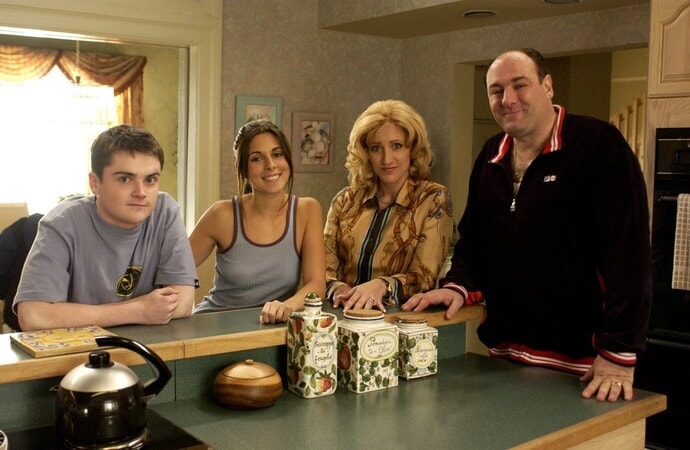
One of the things on my 42 Things To Do list is to watch my personal top ten television series of all time. They’re in no particular order, and I’m not pretending there’s a definitive ranking everyone should agree with. These are my ten. The Sopranos is the first one I’ve finished. I watched it when it originally came out, so this was a rewatch, and these are some thoughts on why it deserves its place on my list. When I first started watching, I was in my early twenties. Now I’m in my mid-forties, with children of my own, and much closer to Tony’s age than I was first time round. That changes how I see it. The family relationships, the parenting, and the behaviour people pass on to their children all mean more to me now. I’m watching the same series with a very different understanding of some of the things happening in it. There are substantial spoilers below. People who look like people One of the things I really appreciated was the casting. There are beautiful people in The Sopranos, but most of the cast look like people you might actually encounter. Particularly the men. Plenty are overweight, ageing, or physically unremarkable. If you saw them sitting in an office, you wouldn’t necessarily give them a second glance. Their behaviour would be a different matter. There’s also room for older people to be at the centre of the story. They have histories, established relationships, and bodies that suggest they’ve spent several decades eating, drinking, and sitting around. You can believe they’ve known each other for years. That contributes enormously to the realism. I don’t need everyone on screen to look as though they’ve just stepped out of a gym or a modelling shoot. Here, the physical presence of the cast helps make the world convincing before anyone has even said anything. Tony, and the family resemblance Tony Soprano is the central character the whole story follows: a New Jersey mob boss trying to run his criminal family while dealing with his wife, children, mother, and his own psychological problems. Spending that much time with him means you inevitably start feeling some sympathy. You see his anxiety, the pressures on him, and the genuinely difficult people he has to deal with. Then, just as you’re beginning to warm to him, he does something truly awful. Sometimes it’s violence. Often it’s something quieter: manipulating someone, humiliating them, or making sure they suffer because he’s unhappy. Understanding him never gives you much opportunity to forget what he’s capable of. I loved watching his mother’s behaviour emerge in both him and his sister Janice. The self-pity, the anger, the manipulation, and the conviction that whatever has happened is somebody else’s fault. They can recognise how difficult their mother is while behaving remarkably like her. Then you see elements of Tony and his wife Carmela appearing in their children, Meadow and AJ. Different combinations, expressed differently, but recognisable all the same. The children react against their parents while also absorbing their attitudes and ways of handling the world. I don’t know whether every little resemblance was deliberately written or performed, or whether I’m reading more into some moments than was intended. Either way, it’s superb. The family relationships feel like they’ve developed over a lifetime. Christopher alongside Adriana and members of the Soprano family. Still: © HBO, via Warner Bros. Christopher, addiction, and trying to stay sober Christopher Moltisanti, Tony’s younger relative and a member of his crew, has one of the strongest stories in the whole series. His relationship with drugs and alcohol is complicated, destructive, and painfully convincing. What makes it work for me is that recovery never neatly resolves the problem. He can want to stop, make progress, and still relapse. There’s no single moment of understanding after which everything falls into place. His addiction remains part of his life, affecting his relationships, his judgement, and the way other people treat him. Compared with stories where addiction becomes a dramatic crisis followed by a fairly tidy recovery, this feels much more realistic. You spend enough time with Christopher to see the repetition, the frustration, and the gap between what he intends to do and what he actually does. Drugs and alcohol also occupy different places in the world around him. His drug use is treated as a serious weakness, but drinking is woven into the crew’s social life. Trying to stay sober means stepping away from something everyone else considers normal. It can make him seem awkward, distant, or less willing to join in. The people around him can demand that he gets better while making it harder for him to do so. They have limited patience for the actual requirements of recovery, particularly when those requirements inconvenience them. Christopher is still responsible for the terrible things he does. But the series gives his addiction enough space for you to understand the struggle without reducing him to either a cautionary tale or someone you’re simply supposed to pity. Powerful men with very fragile egos For men who place so much importance on strength, loyalty, and respect, they’re extraordinarily fragile. A joke, a perceived slight, or the possibility of looking weak can send them into a rage. They have considerable power over other people, but very little ability to manage their own embarrassment, fear, or hurt. The homophobia is a huge part of that world. The series explores men living at a time when attitudes are changing, while carrying expectations they grew up with about what a man should be. Being gay threatens the rules they’ve built their identities around, and their reactions expose how insecure those identities can be. There are cracks in those attitudes, too. Personal relationships, practical interests, and moments of hesitation complicate what they claim to believe. I found that interesting because it helps explain their behaviour without excusing the cruelty that follows. And sometimes their feelings simply become somebody else’s physical problem. I repeatedly felt sorry for the barman, Georgie. He could say something harmless, or do very little at all, and end up being attacked by Tony because Tony was already angry. Those scenes are horrible precisely because there’s so little justification, even by the standards of this world. Someone with less power is available, and Tony takes his feelings out on him. Tony and Carmela Soprano. Still: © HBO, via Warner Bros. The women living with it The women bear the brunt of a huge amount of casual violence and control. Across so many of the relationships, there’s an assumption that the men can do what they like and the women will have to deal with it. The physical beatings are brutal. So is the ease with which affection can turn into intimidation, or a woman’s needs can be dismissed because a man finds them inconvenient. It makes the domestic relationships disturbing in ways that go well beyond the violence between gangsters. Then there’s the ordinary acceptance of mistresses, or “goomahs”, as they’re called in the show. Having a wife and another woman seems to be treated as a routine part of life for these men. They talk about family and loyalty while expecting their own infidelity to be accommodated. The wives aren’t necessarily unaware. There’s a whole set of expectations around what they’re supposed to know, tolerate, and avoid discussing too openly. The men get to compartmentalise their lives, while the women have to live with the humiliation and uncertainty that creates. It says a huge amount about whose feelings matter in these relationships. Carmela’s position is particularly interesting. She benefits from Tony’s money and knows enough about where it comes from to be compromised by it. But she’s also right to worry about what happens to her if he dies or goes to prison. He expects her to live with the risks of his life while being evasive about securing her future. Her attempts to take matters into her own hands make sense in that context. She’s trying to find some control within a relationship where much of the power, information, and money sits with him. Dr Melfi, Tony’s psychiatrist, faces a different decision after she’s raped. She knows she could tell him what happened and who did it. She has very little reason to doubt that he could have the man killed. Her choice not to tell him is one of the most powerful moments in the series. I read it partly as a refusal to sentence someone to death, and partly as a recognition of what accepting Tony’s help would mean. She would owe him. Their relationship would change, and a boundary she’s worked to maintain would be gone. The possibility is there, and she actively chooses to leave it unused. A world that doesn’t need to keep getting bigger I loved how much exists beyond the immediate story. People and events are mentioned without a full explanation. Characters appear in the background, have a few lines, do something important, and then disappear for a while. Some are clearly significant figures in this world without becoming major supporting characters. It gives you the sense that everyone has relationships and histories beyond the scenes you’re watching. The boundaries feel real. So do the networks. I suspect that if The Sopranos were made today, there would be pressure for every series to introduce a new external gang or a bigger boss. First New York, then the Colombians, then the Triads, until Tony was somehow taking on the entire government. Instead, he’s trying to run his own criminal family. He isn’t on a six-series mission to take over every other family and become America’s greatest crime boss. He’s managing unreliable people, money, rivals, loyalties, and the consequences of previous decisions. The problems loop round. The scale stays broadly recognisable. You get more depth because you keep watching these people deal with the world they already inhabit. That’s something I miss in series that keep trying to outdo themselves. We don’t want bigger and badder all the time. We want better. The bits I didn’t love I did briefly worry that it was becoming formulaic. Junior is a threat to Tony, then Richie arrives and becomes a threat, then Ralph takes up a similar space. There was a point where I wondered whether each series would amount to introducing another difficult man for Tony to survive. Ralph lasting across two series helped. The stories overlapped, the relationships developed, and it stopped feeling like everything would reset for the next antagonist. The conflicts became more complicated than a straightforward succession of opponents. I also didn’t find all the acting particularly naturalistic. There are performances where I was very aware of someone delivering their lines. If I were watching purely as a free-flowing acting masterclass, some of it wouldn’t stand up especially well for me. Oddly, that didn’t necessarily spoil it. The delivery often fitted these awkward, blunt, or emotionally limited characters. I could notice a performance feeling stiff and still believe in the person. And I could have done without the coma dream sequences. I understand that the psychological side is central to the show, and I found much of that fascinating. Those sequences just didn’t add much for me. I was more interested in getting back to the people and relationships I’d spent so long following. What stayed with me was how little promise there is of a happy ending in this life. Death, prison, or becoming old, lonely, and diminished seem to be waiting somewhere along the road. The money and power never look like reliable protection against any of it. And then, black The final moments are genius. David Chase has resisted giving viewers a straightforward explanation, pointing them back to what’s already on screen. For me, though, the meaning is clear: Tony is killed by the man who goes into the toilet. The series has already planted the thought that you probably never hear the shot that kills you. You don’t necessarily get a warning, a moment of recognition, or time to understand what’s happening. That idea comes back as you watch the final scene. We’re sitting with Tony and his family, watching people arrive, noticing the man who goes to the toilet, and waiting for something to happen. Then the picture and sound cut off. Black. Tony doesn’t see it coming, and we experience that final moment with him. There’s no shooting for us to watch from a safe distance afterwards. His experience ends, and so does ours. Of course I want to know what happens next. What happens to Carmela, Meadow, and AJ? What happens to everyone else? After spending that much time with these people, you want to follow them beyond that meal. But giving us those answers would change the ending completely. The abruptness is what makes it work. A life ends while everyone around it still has unfinished business. For me, it’s arguably the best ending to any television series. Rewatching it gave me plenty to think about, including things I probably paid less attention to the first time. It thoroughly earns its place in my ten. I first watched it as a man in his early twenties. Watching now, in my mid-forties and with children of my own, I’m much more aware of the family sitting around that table, and of everything Tony’s behaviour has meant for them. I’m closer to his age, with more experience of being a parent, and that makes parts of the series land very differently. One down, nine to go. Cover and article stills: © HBO. Source: Warner Bros’ official The Sopranos Season 5 gallery. View image source.